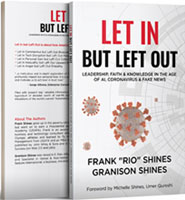
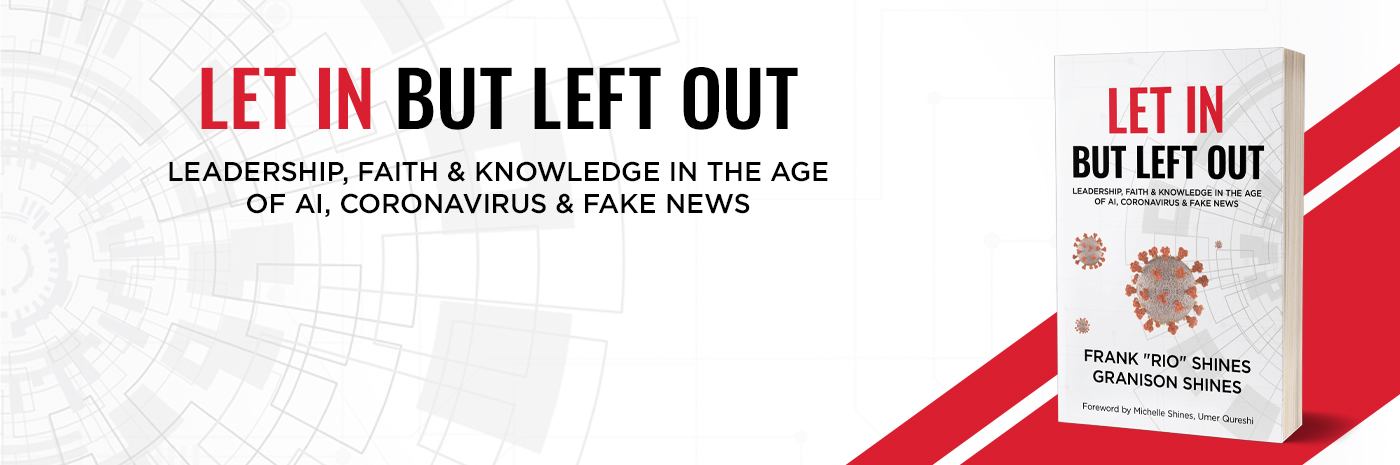
Coronavirus Book: Let in But Left Out
How America Let in Coronavirus and Left out Bio Science
By Frank Shines
April 27, 2020
Coronavirus Book: Leadership, Faith, and Knowledge in a Pandemic

This coronavirus book, Let in (Coronavirus) But Left Out (Bio science) examines the impact of the pandemic on the acceleration of technology trends, fake news, and inequality. Coronavirus accelerates tech, change and inequality (add in the image).
I am a former Air Force officer and business and technology consultant who’s traveled the world with IBM and Ernst & Young helping organizations and people adapt to change. While this coronavirus book is written from my perspective and experiences, my brother, Granison Shines played a vital role in researching, discussing, co-writing, editing and marketing Let in But Left Out.
In The Big Short, Brad Pitt plays the role of an ex-banker, Ben Ricker, who hates big banks. He admonishes the two young investors he is helping, “If we’re right, people lose homes. People lose jobs. People lose retirement savings, people lose pensions. You know what I hate about f****** banking? It reduces people to numbers.” [16]
The Brad Pitt film is based on the Michael Lewis non-fiction book by the same name. It examines the causes of the 2008 financial collapse – the biggest economic meltdown since the Great Depression. The Great Recession, as it came to be known, cost many Americans their jobs, homes and retirement savings. According to Wharton’s Peter Capelli, “One in five employees lost their jobs at the beginning of the Great Recession.” [17]
As I noted in the Preface, I was writing a different version of this book when the novel coronavirus, triggered a global pandemic. Prior to this viral outbreak I had written, “The 2008 financial collapse shocked America. I fear that another shock will happen soon.”
Well, that shock came faster than I expected, and we are now living it.
Like so many others, my family also felt the pain of the Great Recession. Many of my relatives lost their jobs and their houses and had not fully recovered when the virus began to spread. We are now in the throes of a pandemic-caused recession. But this time we can choose to NOT reduce people to numbers. Sales from one of our family-owned businesses in which we work directly with Chinese manufacturers and U.S. small businesses, are down more than 90 percent since the pandemic. We will probably have to shut down operations. Likewise, many of America’s family-owned barbers, daycare centers, salons, restaurants and retailers will never come back.
Throughout this coronavirus book I share real life stories of loss and victory across four generations of my family. Our family survived slavery, World War I, the 1918 Spanish Flu, the Great Depression, World War II and the Civil Rights riots of the 1960s. The Spanish Flu infected 500 million people and killed an estimated 50-100 million worldwide. The Great Depression saw 25% unemployment rates and a 65% collapse in international trade. If we can survive those tragic events, we can survive COVID-19. That is, if we all pull together. [18]
Perhaps my family’s journey can give us all a bit of hope in a time of civil unrest, social distancing, isolation, dislocation and despair.
I am the product of African slaves, Indigenous Peoples and British and Irish slave owners. I embrace all parts of my ancestry. My ancestors arrived in this country in the holds of slave ships about 1690, left the British Empire for a better future circa 1774, survived small pox and marched the Trail of Tears, were freed under Emancipation Proclamation from 1863 to 1865, led the migration West in 1908 and benefited from hard work, America’s technological progress and a rising middle class. Both the Shines and Stroud families took similar routes to flee the repression of the South and head West to make a better life for themselves and future generations. Today, many of us are part of middle-class and forgotten America, and a few of us are part of the 1- and 10- percenters.
My great grandfather, Rev. Kimbal Dolphus (K.D.) Stroud, was the son of an African slave mother and half-British, half-Tawakoni (an Indigenous tribe now part of the Wichita Nation) father. He was also a teacher, poet, pastor, Lincoln Republican and Langston University graduate who strongly believed in education and America’s free enterprise system.
Like K.D. and Lulu, we Americans have always faced great challenges and risen to the occasion. We humans have been blessed with a unique superpower that no other species possesses; it is “the ability to cooperate flexibly in large numbers,” according to the bestselling author and historian, Yuval Noah Harari. Our founding fathers set up a system of government that reinforced this superpower – but, still, they were concerned about America’s future. [19]
John Adams wrote, “Democracy never lasts long. It soon wastes, exhausts and murders itself. There was never a democracy that did not commit suicide.” [20]
America is an experiment, not an entitlement. The 20.4 million military veterans (about 6 percent of the U.S. population) still alive, who took an oath to defend this nation and the U.S. Constitution, understand this statement at more than just an academic level.
In writing this book, I pulled together an analysis of family DNA, congressional hearings, museum gallery photos and artifacts, historical archives, and family photos, letters and publications. Additionally, I drew upon nearly 30 years of projects and experiences from my work in the Americas, Europe, Australia and Asia for the military, government and private industry. Finally, I interviewed dozens of employees, executives and business owners and more than 50 enlisted and commissioned military personnel who transitioned into the civilian workforce. The common theme across this body of work has been to understand how people anticipate and adapt to changes brought on by cultural and technological disruption. I bring those lessons learned to you.
The book is split into three major sections:
- Call for Reflection
- Call for Balance
- Call for Action
Call for Reflection
Reflection and historical perspective can provide context and clues. A Call for Reflection reminds us that our nation has always come together when the stakes were high. Here we focus on the importance and value of reflecting on our familial and national histories. This allows us to identify patterns and draw upon inspiration and lessons learned and invest them into a better future. Finally, spirituality, community and faith provide us comfort in a world of chaos and remind us that there are causes greater than ourselves.
I open with a chapter called Situational Awareness. I first began to learn situational awareness from my father, uncle and coaches as a means of surviving as a black kid growing up in America. The military further perfected my understanding and appreciation for the power and value of situational awareness – the science of BE HERE NOW! This form of awareness helps you to be fully cognizant of your surroundings. In a world of AI-powered fake news, smartphone disruptions, social media bullying and coronastress, situational awareness and “inattentional blindness”, are essential concepts you must understand.
Reflection permits us to pause and take the time to think for ourselves. But we should be aware of our blind spots, so I take you through a chapter called Cognitive Bias and the COVID-19 “Hoax.” Perhaps your favorite news media has taken the position that coronavirus is just like the flu and there is nothing to worry about. Rather than blindly accepting this to be true, first understand the inherent biases we all possess, then study multiple other sources of information. Look at the history, science and data on coronavirus. Assess what other experts say. Consider the risk of being wrong and its potential impact on your life and others.
Additionally, reflection allows us to consider history. History provides us with clues in the form of stories and cause-and-effect patterns. The unfolding of events across an arrow of time helps us make predictions about the future. As we await a vaccine for COVID-19, we can learn from countries farther along the epidemic curve and from other nations’ previous experience with coronaviruses such as SARS in 2002 and MERS in 2012. Indeed, we should combine history, data, science, critical thinking and our imagination to “flatten the curve,” save lives and create the type of future society we aspire. [21]
Thank you for reading this excerpt from the coronvirus book, Let in But Left Out. For free book excerpt, click here.
Below is the coronavirus book Table of Contents:
- Preface
- Introduction
- Call for Reflection
- Situational Awareness
- Cognitive Bias & the COVID “Hoax”
- Trans-Atlantic, Trail of Tears & The Rockies
- Olympic Dreams & Wings from Heaven
- A Loss of Faith?
- The AI-Bioscience Generation
- Ray Meets Raj: Inequality & Oligarchy
- Call for Balance
- Let in Coronavirus but Left out Bio Science
- Let in Virtual but Left out Reality
- Let in Disruption but Left out Transition
- Let in Fake News but Left out Critical Thinking
- Let in Personal Gain but Left out Collective Purpose
- Call for Action
- FAULT Leadership
- Leave no Soldier Behind: Military Vets in Transition
- Conclusion
- Get Phygital!